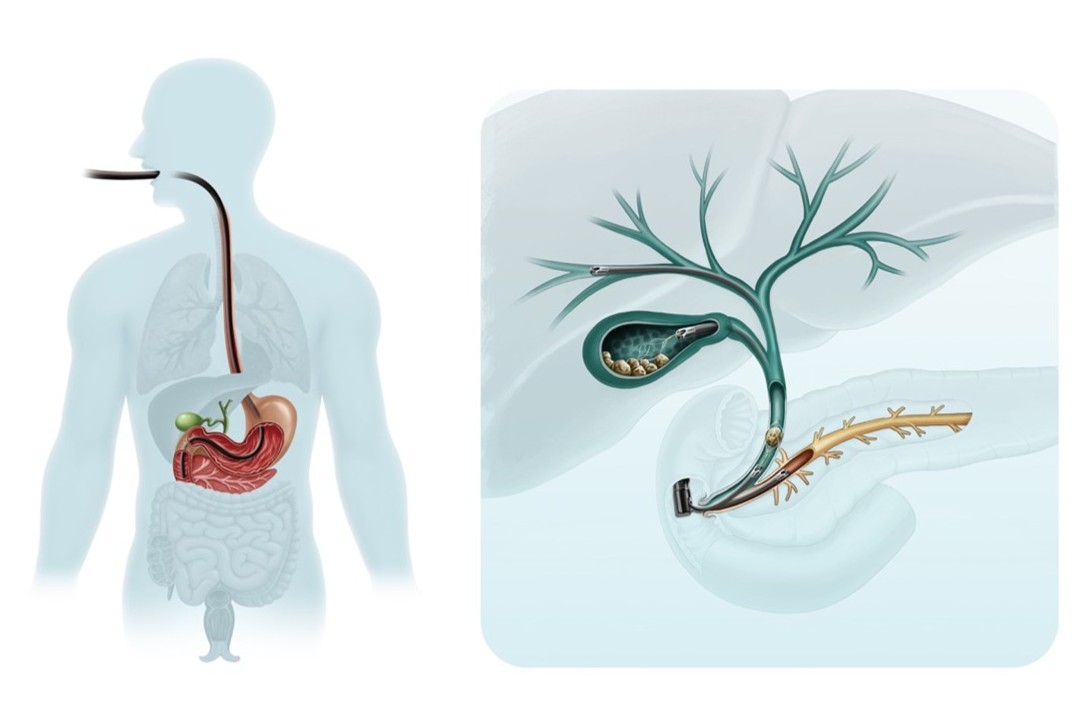
Peroral cholangioscopy is a technique that allows direct visualization of the biliary tract to diagnose and treat problems in the biliary system.
What you need to know first
- The word “peroral” means that the endoscope is inserted through the mouth. A variant of cholangioscopy, percutaneous cholangioscopy, requires making a small incision in the skin.
- A newer technique for peroral cholangioscopies involves the use of an ultrathin endoscope, which can enter very fine ducts to remove large or complex stones.
- The biliary system is a network of organs and ducts that creates, stores, and releases bile to aid digestion, including the liver, bile ducts, and gallbladder.
Overview
Your biliary system is a branchlike system that makes, stores, and moves bile through your body. The branches are your bile ducts. A bile duct carries bile from the liver to your gallbladder and duodenum (the first part of your small intestine). Your pancreatic duct carries pancreatic juice from your pancreas to your duodenum. The bile duct and the main pancreatic duct join to empty into the duodenum via the papilla of Vater, allowing both juices to mix and help digestion.
Your biliary system is crucial for breaking down and digesting food. Problems in one organ can lead to inflammation of the others as they are linked. Blockages in the system can prevent bile flow. For example, gallstones, which are the hardened pieces of excessive bile that form in your gallbladder and become stuck in the common bile duct, can lead to severe pain, indigestion, or even jaundice (yellowing skin and eyes) in severe cases.
Research has shown that Western Europe has the highest prevalence rate for gallbladder and biliary tract diseases at 4010 cases per 100,000 people, and high-income countries carry a greater absolute burden than less developed countries in general.
Peroral cholangioscopy can be used to identify and treat blockages in the biliary system, such as large and difficult to remove bile stones, gallstones, and pancreatic duct stones. It can also be used to collect tissue samples for pathological examinations.
Who may need a peroral cholangioscopy
A cholangioscopy can help with the following conditions:
- Biliary or pancreatic duct stones
- Bile duct blockage or infection
- Duct strictures (narrowing bile duct that prevent the proper flow of bile)
- Bile duct cancer
Why choose to perform a peroral cholangioscopy
A peroral cholangioscopy, especially when the ultrathin endoscope is utilized, is advantageous in several ways:
- Minimally invasive, which avoids open surgery.
- Direct visualization of the biliary system for real-time inspection.
- Can be used with a wide range of accessories to treat different conditions, including stone retrieval, widening the duct strictures, and other conditions.
What to expect during a cholangioscopic procedure
- Anesthesia: The procedure is often painless.
- Endoscopy insertion: Your doctor will insert the endoscopy through your mouth down to your duodenum.
- Cholangioscope insertion: The MICRO-TECH eyeMAX cholangioscope will be inserted through the endoscope to the bile ducts for direct visualization. High-resolution images will be projected onto the monitor for inspection in real time.
- Treatment: Your doctor will pass tiny tools through the endoscope to perform treatment. For example, sound waves or laser beams may be used to break bile duct stones into smaller pieces so that they are easier to retrieve.
After a peroral cholangioscopy
Depending on your doctor, you may be asked to:
- Monitor for signs of nausea, abdomen pain and other conditions.
- Follow a clear-liquid diet.
Understanding risks
- Side effects from the anesthesia, such as drowsiness.
- Sore throat due to the endoscopy insertion through your mouth.
- Bloating as doctors may need to pump air into the gastrointestinal tract for clearer visualization.
- Infection of the bile ducts (cholangitis).
- Infection of the pancreas (pancreatitis).
Information on this site should not be used as a substitute for talking with your doctor. Always discuss with your doctor about diagnosis and treatment information that is specific to your condition.